Point 3. Envision the Future
Envision the Future is designed to create a change acceleration strategy and plan to communicate, train, and engage the employees of the organization in their cloud adoption journey. It contains seven subpoints:
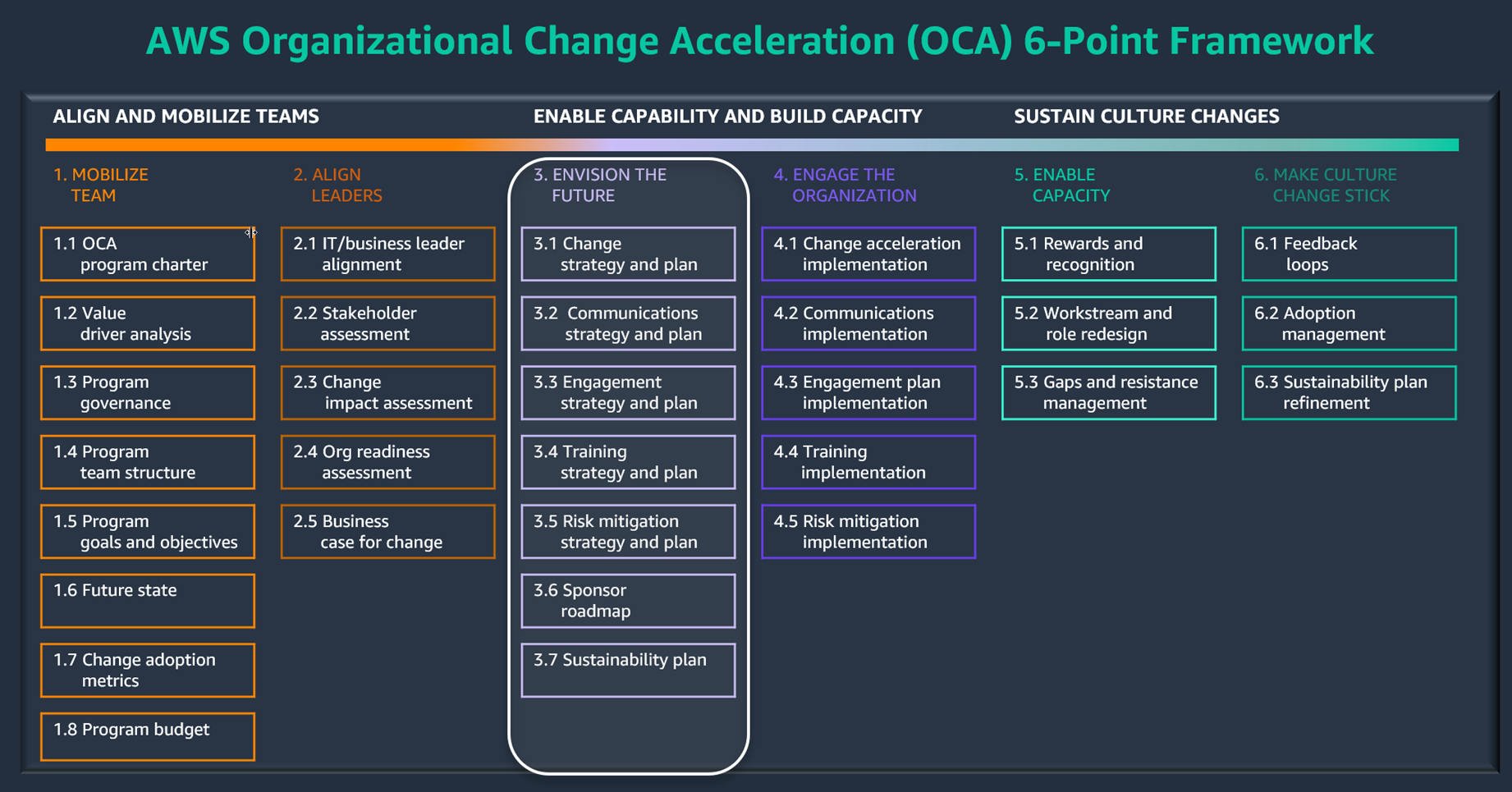
3.1 Create change acceleration strategy and plan
What is it?
A change acceleration strategy and plan provide a thoughtful, structured approach to delivering the right change tactics to the right people at the right time throughout the course of the cloud transformation. These serve as a framework that outlines a comprehensive approach to ensure that changes introduced to the organization as a result of the cloud transformation journey are accepted by leaders, employees, and other stakeholders with minimal disruption and maximum results. The plan provides a systematic mechanism for adjusting the application of tools, technologies, processes, or skills during a project or initiative. It describes the specific ways in which the organization will address such changes in the way it operates its business, technology, supply chain, organizational structure, or project scope. The strategy provides direction and results in informed decision making throughout the cloud transformation process.
Why is it valuable?
New systems and strategies can be highly disruptive to an organization. A well-formulated strategy describes how the project or change will affect the organization. To institute an organizational change management strategy effectively, stakeholders must create a plan for how to recognize when a change is needed, how to approve changes, and how to monitor changes to make sure that they have produced the desired effect.
Having a change acceleration strategy can help ensure that your transition to the desired future state goes smoothly. It can help minimize risk, performance issues, business disruptions, and incremental costs. It can help ensure that business continuity and service levels to customers are maintained. It can secure leadership alignment, and help ensure that all affected audiences are accounted for and prepared for the change. It can be utilized to increase stakeholder awareness, engagement, and understanding, and foster cultural transformation to promote collaboration and new ways of working. Finally, this strategy can be valuable in teaching the organization how to adopt and sustain the change to meet objectives and position itself for ongoing success.
When do you use it?
The change acceleration strategy should be created at the onset of the program, and the change acceleration plan should be created, reviewed, and updated at key milestones, phases, releases, or epics within the program. Organizational change acceleration is a process that requires close collaboration among teams and employees. This strategy and the subsequent plans require you to develop and maintain effective partnerships among the human resources team, the cloud transformation team, executive sponsors, leadership, external vendors, and AWS Partners.
3.2 Create communication strategy and plan
What is it?
A communication strategy and plan provide a thoughtful, structured approach to delivering the right messages to the right people at the right time throughout the course of your cloud transformation. Communication from executive leaders is key to reinforcing the value and benefits of cloud transformation, and input from cloud project leaders, cloud change leaders and agents, the internal communications team, and human resources is critical to the development of the communication strategy and plan.
A communication strategy is a document that expresses the goals and methods of an organization's outreach and communications activities. A communication plan includes the detailed information about communications activities that address the strategies and achieve the objectives listed earlier. The plan describes each activity and includes information such as the delivery date, intended audience, detailed message, media type, creator, approver, and messenger. The communication strategy is typically updated infrequently, whereas the communication plan is updated on a frequent (typically weekly) basis.
Why is it valuable?
As your cloud transformation evolves, your communications teams must ensure that messaging is solidified and ready to be deployed throughout your transition to the cloud. An effective communication strategy and plan account for all necessary activities. This visibility makes it easier to understand how the cloud transformation story unfolds for the audience groups and helps you set deadlines for the work effort.
Communications promote cloud transformation and change acceleration awareness, which is the first step in getting a group of people to embrace new ways of working. Communications also cover the cultural aspects of the change and provide the answer to the question "What's in it for me?". Furthermore, communications motivate future state and transitional state behavior. Setting a communication cadence reduces uncertainty and minimizes resistance to, and risk of rejection of, changes. A communications strategy gives key stakeholders the ability to drive awareness, understanding, and commitment across the cloud transformation project.
When do you use it?
In the planning phases, developing a communication strategy and plan is important, and how well you implement these could be the determining factor in how well the transition is received and behaviors adopted by your organization. Communication strategy and planning efforts start at the beginning of your cloud transformation project―typically during the migration readiness assessment. During this phase, gaps, change impacts, and teams and employees who are affected by the migration are identified. When you build your communications strategy, follow the communication process within your organization to best architect cloud messaging and activities.
3.3 Create engagement strategy and plan
What is it?
The engagement strategy and plan outline a systematic approach that describes specific ways in which an individual, stakeholder group, or organization will address changes brought forth by the cloud transformation. The intent of the engagement plan is to keep all key stakeholders committed to and focused on the desired business results of the cloud transformation. Identifying stakeholders and engaging them appropriately throughout the change process is critical to the success of the project. The strategy and plan should include input from the cloud project leader, change acceleration Leader, training leader, members of the readiness assessment team, internal training department, and human resources.
Why is it valuable?
The engagement strategy and plan heighten the involvement within and outside the cloud transformation team. It ensures that the right people receive the right information, so they can participate at the right time and in the right way. It works as a forcing function to proactively manage the pace and amount of change that each stakeholder group must undergo at a specific project milestone to avoid overload. By creating an engagement strategy and plan, you actively involve stakeholders, which might help further identify, manage, and avoid potential roadblocks. The resulting additional organizational commitment and capability for cloud transformation change further maximize the potential for a successful transition to cloud adoption.
When do you use it?
Use an engagement strategy and plan after you complete your preliminary work of assessing stakeholders, creating a change acceleration strategy and plan, and creating a communication strategy and plan. These documents can serve as a way to drive ongoing support and to benefit from the influence of stakeholders.
3.4 Create training strategy and plan
What is it?
A training strategy and plan identify the training that has to be delivered, and the process for developing and delivering the training program. These documents help users make the connections between the information they received from the communications team and the way they will work in the future to perform their roles in a cloud-transformed future state. To deliver training that meets the requirements of your cloud team, it's essential to create a training program that identifies training needs, outlines training to support those needs, and develops and delivers the training. The training strategy outlines the approach and process that will be followed to create and implement the cloud migration or modernization training program. It includes a learning needs assessment, a high-level approach to develop and implement the training program, and an overview of the development process for training materials.
A training strategy is a document that expresses the goals and methods of an organization's learning and enablement activities. A training plan includes the detailed information about training activities that will address the strategies and achieve the objectives of cloud migration, modernization, or transformation. The plan describes each training artifact and event, and specifies the delivery date, intended audience, detailed message, training format, creator, approver, and instructor for each event. The training strategy is typically updated infrequently, whereas the training plan is updated on a frequent (typically monthly) basis.
An AWS
Learning Needs Analysis
Beyond AWS technical skills, other competencies, new ways of working, process-related training, and methodology training might have to be part of your holistic training strategy and plan. For example, if your organization is trying to foster better collaboration, your strategy and plan might have to explain how to work together by using collaboration tools. If your organization is moving from a waterfall model to an agile approach, you will need to provide training for the agile method, tools, processes, and cadences. Other common examples are data analytics and cloud leadership skills.
Why is it valuable?
Developing a training strategy and plan enables an organization to align knowledge, skills, and capabilities to organizational goals while also demonstrating the value of investments for training programs.
An AWS Learning Needs Analysis produces learning recommendations for continued growth and provides a data-driven approach to workforce cloud acumen with practical application of results.
When do you use it?
Training strategy and planning efforts start at the beginning of your cloud transformation project. During this phase, gaps and change impacts are determined, and the teams and employees who are affected by the migration or modernization are identified.
An AWS Learning Needs Analysis can be conducted before a program starts, to baseline the organization's skill set, or it can be run later in the program, after the cloud transformation has been announced and leaders are looking to budget and plan training curriculum.
3.5 Create risk mitigation strategy and plan
What is it?
A risk mitigation strategy and plan are designed to eliminate, reduce, or control the impact of an organization's exposure to potential risks in a timely manner. These documents provide a mechanism for periodically evaluating how the cloud transformation is going by using an evaluation tool that consistently evaluates risks across the program and that can be used at a regular cadence or at a scrum ceremony. By using a risk mitigation strategy and plan, you can determine priorities for action and assess risks before they become issues. Owners can be assigned for risk management and corrective actions. These documents set the dimensions by which the change acceleration team can categorize risks; for example: vision and clarity, culture, commitment, communications, retention and engagement, skills and capability.
Why is it valuable?
Establishing a risk mitigation process offers a structured way to gain visibility into the people-related issues that can stall, derail, or delay a cloud transformation. It allows for a consistent review of the status of the project as the team moves through the designated phases for the lifecycle of the program. This process helps ensure that deliverables are on time, on budget, and produced with high quality. It also offers an integrated approach with the cloud transformation team to identify, assess, and address risks.
When do you use it?
Use a risk mitigation strategy and plan when the program kicks off to design the format and establish risk dimensions. Review the strategy and plan on a regular cadence, and update them as required.
3.6 Develop sponsor roadmap
What is it?
A sponsor roadmap is a document that encourages leaders to demonstrate their support for changing processes and behaviors as part of the cloud transformation and transition to the future state organization. It serves to collaborate with leaders and promote the benefits and value of the future state organization, build a comprehensive support plan, and hold leaders accountable for actions asked of them in strategic alignment with the cloud transformation.
Why is it valuable?
Active and visible sponsorship is the primary driver for successful cloud migration, modernization, and adoption. Active engagement and presence are instrumental in establishing the desired behaviors expected of individuals and organizations. A structured process secures consistency in messaging and helps achieve the intended organizational objectives. Individuals will follow if their leaders are communicating regularly and demonstrating the behaviors expected of them.
When do you use it?
Secure sponsor commitment from the beginning of the cloud migration and modernization. Provide general awareness and understanding of the sponsorship process to executives and cloud migration/modernization leaders. Onboard sponsors appropriately and provide role descriptions, accountability, key messaging, sponsorship roadmap, and timeline. Reinforce the message that the change acceleration team will be involved in every step of the process to ensure commitment. Key messaging reinforces the cloud migration vision, benefits, and overall business value.
3.7 Develop sustainability plan
What is it?
A sustainability plan provides a proactive approach for transitioning organizational change acceleration (OCA) activities from project status to business as usual (BAU). It describes the desired future state behaviors and organizational structures beyond the initial phases of cloud migration or modernization. The plan helps establish the ongoing adoption of cloud technologies, the use of repeatable patterns and processes, and continuous training efforts in alignment with evolving technologies. By developing this plan early in the cloud journey, you can create a roadmap for ensuring ownership of the cloud transformation and minimize the risk of abandoning the project soon after its adoption. The sustainability plan continues beyond the initial cloud transformation effort to drive the original vision, business value, and benefits over the long term.
Why is it valuable?
The sustainability plan looks beyond the initial cloud migration phase to help the organization adopt the future state model and stand the test of time. It provides a mechanism for future-proofing the cloud transformation as people and technologies evolve. An effective sustainability plan ensures long-term adoption of cloud technologies and practices, reduces the risk of reverting to old ways of working, embeds cloud-centric culture into the organization, maximizes return on investment (ROI) in cloud transformation efforts, and supports continuous improvement and innovation. In the early stages of the cloud journey, the move to the cloud is treated as a high-priority project with dedicated behaviors and activities. At some point, however, the journey should stop being treated as a project and become business as usual. Sustaining improvement gains over time requires a proactive and systematic approach for creating internal sustainability and ownership.
When do you use it?
Initiate the design of the sustainability plan in the Envision the Future stage of the cloud transformation lifecycle, and then scale the program as you progress. It is typical for cloud migration and modernization teams to iterate and experiment with how they operate, so creating a sustainability plan too early might result in some rework, but planning for sustainability from the beginning is critical to long-term success.
Align planning activities with the cloud leadership team to understand and establish expectations beyond the initial phases of the cloud transformation journey. It is critical to consider organizational changes; gaps in positions, roles, and responsibilities; communication needs; additional training requirements; knowledge libraries or repositories; and business metrics correlated with OCA measures. As the project progresses and the team works more rapidly and scales, the sustainability plan evolves frequently. Capture needs from status meetings, retrospectives, and risk, action, issue, dependency (RAID) logs throughout the cloud journey to make sure that the sustainability plan stays current and accurate.
When developing the sustainability plan, review your cloud strategy and objectives to determine if you are on track to achieve desired business outcomes. Develop the vision and goals for organizational change acceleration ownership of the future state. Evaluate your organization's ability to own and sustain each major component of your OCA strategy, including business value tracking, leadership commitment, culture change, communications, training plans, and talent strategies. For each component, consider resources, competencies, processes, structure, behaviors and tasks, and consequences and incentive systems.
Plan early for how ongoing OCA activities will transition from the project team to sustained operations. Identify what formal structures and responsibilities need to be established and plan timeframes to re-evaluate ownership at intervals after project completion. Consider mechanisms to formalize change measurement through quarterly reporting, integrate cloud adoption metrics into employee performance plans, dedicate employee time to monitor cloud adoption, and align cloud-related activities with formal processes such as annual performance plans and compliance training.
Address how communications, training, and metrics will continue beyond the initial transformation. Plan for transitioning communications management to the customer organization or sustaining function, including identifying communication champions and developing a communications roadmap. Plan to address training gaps discovered after migration, provide follow-up training plans, and create archives of training materials. Ensure that ongoing collection and monitoring of key metrics at multiple organizational levels will be in place, with data collection plans, automation, responsible, accountable, consulted, informed (RACI) matrices, and response plans.
Consider how to implement knowledge transfer programs such as shadowing processes, creating a cloud transformation playbook, and developing mentorship programs. Plan for conducting cultural assessments to measure how well new ways of working are ingrained in operations. If you have a Cloud Center of Excellence (CCoE), plan to evaluate capability maturity and how the CCoE should evolve from a project-focused entity to a strategic driver of ongoing cloud innovation. Determine who will need to approve the completion of change acceleration activities and the transition to steady-state operations.
When you include these planning activities as part of your initial sustainability plan, your organization will be well-positioned to sustain change and cloud adoption over the long term. Being patient, persistent, data-driven, and methodical will help your organization adhere to the sustainability plan and ensure that cloud investments continue to yield benefits well into the future.