Point 6. Make It Stick
Make It Stick takes the work of the change acceleration framework and builds sustainability to stand and last the test of time. In this workstream, you create feedback loops for repeatable patterns and lessons learned, actively manage adoption, and create a post-implementation and sustainability plan so that the change acceleration team can be disbanded, and the changes, behaviors, and culture that has been created can be operationally and passively (rather than actively) managed. Make it Stick has three subpoints:
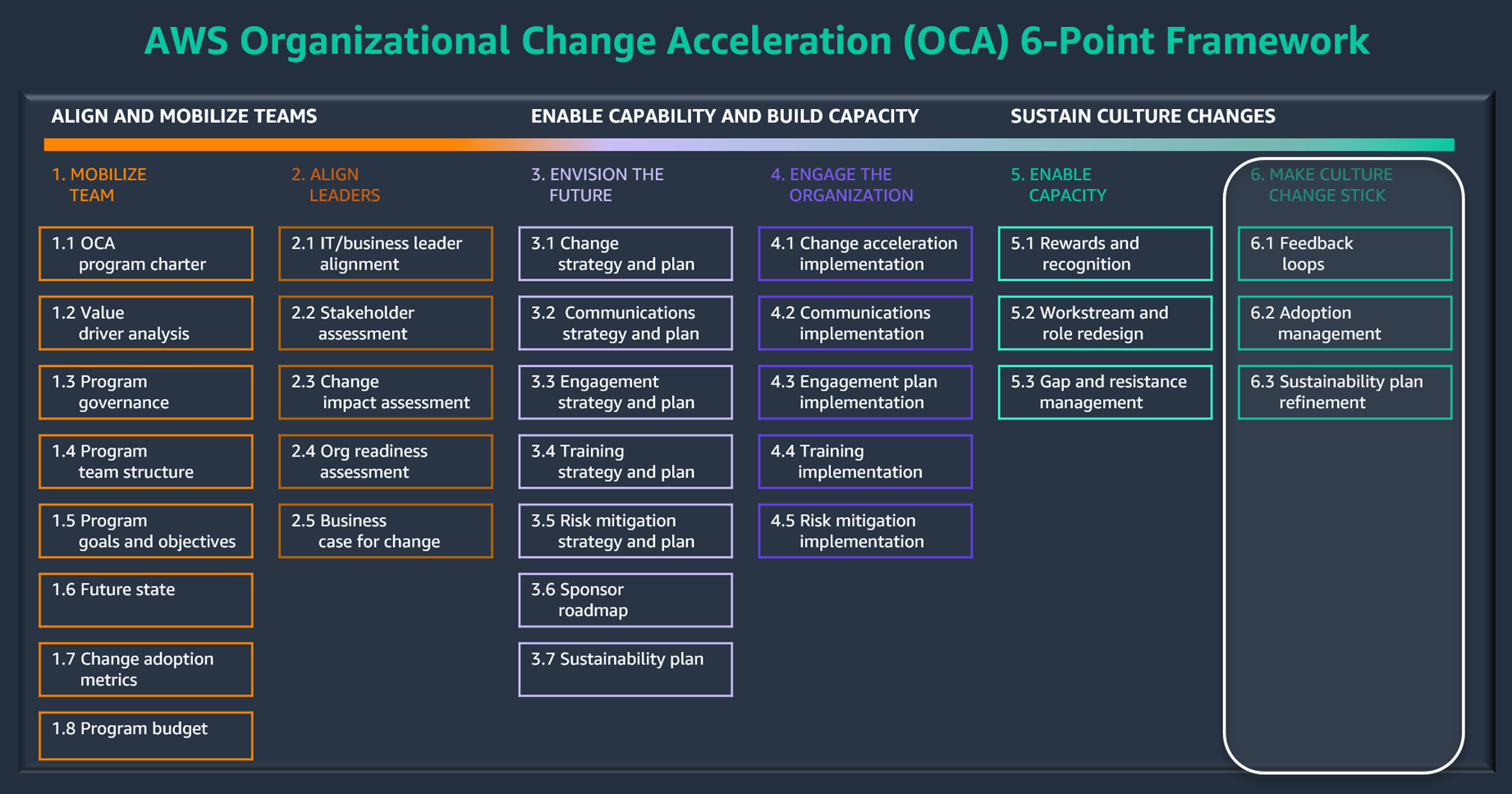
6.1 Establish feedback loop
What is it?
A feedback loop enables an organization to adjust its performance by giving employees an opportunity to respond to changes that result from cloud transformation in a healthy and authentic way. The primary objectives of a feedback loop are to support two-way information sharing, involve key stakeholders throughout the project, and collect information to monitor communication effectiveness. Some useful channels for feedback loops include one-on-one interviews; focus groups; team, department, and staff meetings; engagement or organizational readiness surveys; communication portals; and project mailboxes. If your organization uses a social media tool, you can also monitor those channels to gather feedback in the form of comments, sentiment, likes, dislikes, traffic, and so on.
Why is it valuable?
Establishing a feedback loop enables you to collect honest reactions from stakeholders and refine (and continuously improve) change acceleration activities based on actual data. An easy-to-use tool makes the feedback easy to gather, analyze, and incorporate into cloud transformation activities. However, a feedback loop becomes powerful and effective when you act on the feedback, communicate that the feedback was received, and identify the changes that were made as a result of the feedback. This helps the program improve as a direct result of feedback, and gain credibility as an indirect result of feedback.
When do you use it?
Ideally, feedback loops should be incorporated into the plan as part of measurement. In designing the feedback process, determine a reasonable timeframe for responding to inquiries or comments. Consider the timeliness of providing feedback in relation to the program's speed and cadence. For example, feedback that is captured on a weekly, biweekly, and monthly basis can then be used as input into a scrum retrospective meeting.
6.2 Create adoption management checklist
What is it?
An adoption management checklist helps ensure the effectiveness of change acceleration activities and gauge overall cloud transformation adoption. The adoption management checklist validates that leaders and stakeholders are prepared, are engaged, and understand the benefits and business value of moving to a new Cloud Operating Model. This activity assumes that all foundational plans are developed and approved for implementation, including change, communication, risk, and training strategies and plans.
Why is it valuable?
An adoption management checklist is valuable in tracking eight key success factors associated with cloud transformation: visible and committed leadership, compelling need for change, clarity of direction, broad-based participation, targeted and effective communications, single program focus, measurable goals, and disciplined project management.
When do you use it?
Reviewing the adoption management checklist on a quarterly basis provides a mid-range planning horizon for the cloud transformation team, and enough flexibility to make adjustments as required. As action plans are created as a result of findings, they can be tracked as part of regular (weekly or biweekly) scrum activities.
6.3 Develop post-implementation and sustainability plan
What is it?
A post-implementation and sustainability plan is the continued refinement of the sustainability plan developed in Envision the Future. This plan is crucial for ensuring the long-term success of cloud transformation, even after the dedicated transformation team disbands. The objective is to ensure that people-related mechanisms remain in place and evolve following a cloud transformation effort, establishing enduring mechanisms to maintain and evolve cloud adoption practices and embed these into the organization's foundations. By focusing on sustainability, organizations can secure lasting returns on their cloud investments, maintain momentum in innovation and efficiency gains, adapt more readily to emerging cloud technologies and practices, and foster a culture of continuous improvement and cloud fluency.
To ensure that change persists, is embedded, and is sustainable, consider the following:
-
Formalize the change measurement through quarterly reporting to the change sponsor or other senior executive.
-
Integrate cloud adoption metrics into employee performance plans or job responsibilities.
-
Dedicate a percentage of full-time employees' time to monitor and drive cloud adoption.
-
Align cloud-related activities with other formal processes and policies such as the annual performance plan, compliance training plans, hiring plans, and budgeting processes.
Why is it valuable?
When a major step of the cloud transformation process (such as migration or modernization) is complete, additional changes are likely to emerge. Creating a long-term strategic plan to sustain those changes is essential. For example, changing the culture or behavior in one area of the organization might result in a process change in another area, or cloud success might need to be scaled across other business units. Sustaining improvement gains over time requires a proactive and systematic approach for creating internal sustainability and ownership.
When do you use it?
Every cloud transformation involves a number of stakeholders and implementors of the change acceleration plan. As you complete the initial stages of cloud transformation, refine the sustainability plan to address ongoing needs and embed cloud adoption into standard operations. It is important to identify who should be involved in the ongoing sustainability of the change project. You can then set timeframes to re-evaluate and review ongoing ownership at intervals after the official completion of the project (for example, after 3 months, 6 months, or 12 months, depending on the project duration). Depending on project requirements, you might also have to develop a continuous improvement plan or an ongoing review plan to monitor and evaluate your change. A continuous improvement plan might include:
-
Purpose
-
Governance structure
-
Roles and responsibilities
-
Calendar of events, review, and feedback sessions
-
Ongoing measures of success
Review your change planning materials and feedback to identify key risks that could be addressed with future change projects and unexpected feedback that has emerged. Prioritize potential future changes and conduct a high-level change impact assessment. Identify future change sponsors and document OCA processes and procedures for reuse. Identify OCA activities that need to be completed or should continue beyond the life of the initial cloud projects and determine what formal structures and responsibilities need to be established or assign to standard roles.
In addition to evaluating stakeholders for sustainability, ensure that planned communications continue beyond the initial cloud transformation. Make sure that communication champions are ready to accept the transition and that the team is adequately trained, has the time to accomplish the tasks, and is technologically ready to support the program. Identify the right resources to manage ongoing communication at the conclusion of the active cloud migration or modernization project. Key actions to consider include:
-
Developing a transition plan.
-
Identifying ongoing communication champions.
-
Meeting with communication champions to outline roles, responsibilities, hierarchy, and action items.
-
Conducting a transition meeting to confirm next steps.
-
Developing a communications roadmap.
Additionally, you will need to address training gaps that were discovered after cloud migration or modernization. Key considerations include:
-
Reviewing feedback, lessons learned, and changes.
-
Soliciting feedback from participants.
-
Developing additional training support materials as appropriate.
-
Documenting a future state training plan (for example, training for new hires, quarterly or event-driven training refreshers, training on new AWS solutions and services, AWS certification and re-certification plans).
-
Creating a cloud transformation archive of all associated training materials (project plan, audit and assessment findings, training strategy, curriculum outlines, finalized documentation, evaluation forms, and so on).
-
Developing a plan for updates and revisions of materials.
An important factor in sustaining change and cloud adoption is the ongoing collection and monitoring of key metrics. Identify the key metrics at multiple organizational levels that are indicative of achieving the planned business outcomes. For each level of metrics (organizational change acceleration, cloud program and workstream, and business outcomes), ensure that a data collection and measurement plan, plan for automation, responsible, accountable, consulted, informed (RACI) matrix, and response plan are in place to ensure sustainability.
Determine who needs to approve the completion of change acceleration activities. Organize meetings with the change sponsor and business leaders to discuss any new change projects, transition of ongoing ownership, outstanding items, and approval of project deliverables.
When you include these activities as part of your sustainability plan, your organization will gain a better understanding of how well change is persisting within the organization. Being patient, persistent, data-driven, and methodical will help your organization adhere to the sustainability plan and ensure that cloud investments continue to yield benefits well into the future.