Configure TIP for an OIDC provider
Use this page to configure TIP for a new or existing OpenID Connect (OIDC) provider. First, complete the prerequisites and planning steps in Before you configure TIP.
For OIDC federation, TIP configuration is stored on an IAM OIDC provider resource. To use Google, Facebook, Amazon Cognito, or another OIDC identity provider with TIP, register it as an IAM OIDC provider and configure TIP on that provider. Built-in OIDC federation paths that do not create an IAM OIDC provider resource do not support TIP configuration.
Configure TIP when creating an OIDC provider
AWS Management Console
To configure TIP when creating an OIDC provider (console)
-
In the IAM console, choose Identity providers, and then choose Add provider.
-
For Provider type, choose OpenID Connect. Enter the Provider URL and Audience as described in Create an OpenID Connect identity provider in IAM. Do not choose Add provider yet.
-
Under Trusted identity propagation - optional, keep Configure trusted identity propagation selected.

-
Under Start from a template, choose how to begin:
-
Choose Okta, Microsoft Entra ID, Ping, or Google Workspace to start with suggested mappings for claims commonly provided by that identity provider.
-
Choose Custom to configure the mappings yourself.
You can change any suggested mapping before creating the provider. A template configures only TIP mappings. It does not change the provider or role trust settings.

-
-
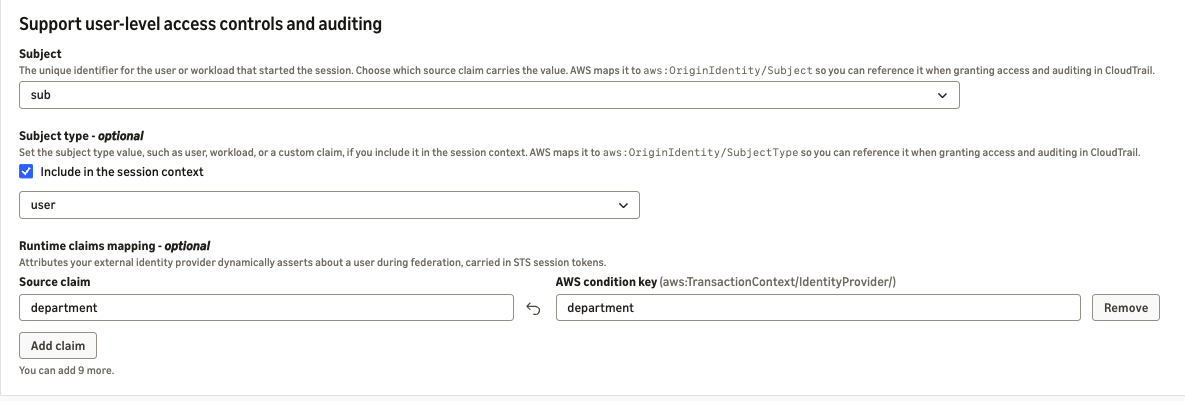
For Subject, choose one source claim that identifies the end user:
-
Choose a source claim offered by the selected template.
-
For Custom, enter the exact claim name from the OIDC token.
The claim must contain one value and must be present in the token. If the claim is absent, the federation request fails. TIP attaches its value to
aws:OriginIdentity/Subject.The IAM console requires a Subject source. If you submit the form with the Subject empty, the console displays Subject is required. and does not save the configuration.
Choose a stable and unique Subject. If you configure group-based access, the Subject value must match the end user's Username in IAM Identity Center.
-
-
Under Subject type - optional, keep Include in the session context selected to attach a Subject type, or clear it to omit the Subject type. If selected, choose how to identify the end user as a human user or workload. TIP attaches the selected value to
aws:OriginIdentity/SubjectType:-
Choose user or workload to apply a fixed value to every federated session.
-
Choose Custom claim from your token to derive the value from a source claim. The source claim must contain
userorworkload.
If you choose the custom option but leave the claim field empty, the console displays Subject type is required. and does not save the configuration.
-
-
To propagate additional context about the session, configure optional runtime-claim mappings. Under Runtime claims mapping - optional, choose Add claim for each source claim that you want TIP to attach. You can add up to 10 mappings:
-
For Source claim, choose a listed claim or enter a custom claim name.
-
For AWS condition key (aws:TransactionContext/IdentityProvider/), enter the target-key suffix, or leave it empty to use the source claim name as the suffix.
-
To delete an unsaved mapping, choose Remove.
-
If a row has no source claim when you submit the form, the console displays Source claim is required. and does not save the configuration.
Each mapped source claim must contain one value. IAM attaches a mapped runtime claim only when the token contains it.
Select identity context appropriate for your authorization and audit requirements. Before saving the mappings, review Logging TIP activity with AWS CloudTrail to understand how selected TIP context appears in CloudTrail events, which customer account receives each event, and how governance controls prevent the context from being logged to unapproved destinations.
Before saving, confirm that each configured source value, source key, and target-key suffix meets the source-value requirements and key requirements.
-
-
Under Support group-based access for users, keep Allow granting permissions to groups selected if your use case requires access based on the end user's group membership. The console hides this section when Subject type is fixed to
workload.Complete the applicable instance-selection or instance-creation path in Configure group-based access for TIP.
-
Choose Add provider. IAM creates the OIDC provider and saves the TIP mappings configured on the form.
-
Complete the OIDC federation setup by creating a role that trusts the provider. TIP does not change or replace the role's trust-policy requirements. For instructions, see Create a role for OpenID Connect federation. For a recognized shared provider, see Identity-provider controls for shared OIDC providers.
Create using the AWS CLI or AWS SDK
To create an OIDC provider with TIP programmatically, call the public CreateOpenIDConnectProvider API. Use aws iam create-open-id-connect-provider with the AWS CLI or create_open_id_connect_provider
The request includes the existing Url and ClientIDList parameters for the OIDC provider. To configure TIP, include the ContextProvider parameter. If you need group-based access, also provide the ARN of the IAM Identity Center instance through the optional IdentityCenterInstanceArn parameter.
AWS CLI and SDK requests do not apply the console's templates or defaults, so you must define the TIP mappings explicitly. ContextProvider is the TIP mapping configuration for the IAM identity provider. When the AssumeRoleWithWebIdentity API operation succeeds, AWS STS uses these mappings to attach selected claims from the verified OIDC token to the resulting role session.
ContextProvider contains the following settings:
-
Subject:
SubjectSourceKeyidentifies the token claim whose value becomesaws:OriginIdentity/Subject. This setting is required. -
Subject type:
SubjectTypeValuesupplies a fixed value, orSubjectTypeSourceKeyidentifies a token claim that supplies the value. This setting is optional. Use one member, not both. The value must beuserorworkload. -
Runtime claims:
KeyDefinitionListoptionally maps additional claims. In each mapping,SourceKeyidentifies the token claim andTargetKeyis appended toaws:TransactionContext/IdentityProvider/to form the condition key.
Every configured source key and target-key suffix must meet the key requirements.
Each configured source must contain one valid value. For the supported value types, length, characters, and failure behavior, see Source-value requirements.
To map a member of an object claim nested one level, use <claim>/<member> as the source key. Arrays and deeper nesting are not supported.
Follow these steps to create the OIDC provider and save its TIP configuration using the AWS CLI or AWS SDK:
To configure TIP when creating an OIDC provider (AWS CLI or AWS SDK for Python)
-
Define the TIP mappings. The following example maps
subto the Subject, sets the Subject type touser, and maps the exampledepartmentclaim to the target-key suffixdepartmentName.{ "SubjectSourceKey": "sub", "SubjectTypeValue": "user", "KeyDefinitionList": [ { "SourceKey": "department", "TargetKey": "departmentName" } ] }Replace
departmentwith a claim that your OIDC provider includes in its tokens. -
Prepare group-based access, if needed. Obtain the applicable IAM Identity Center instance ARN by following Choose the IAM Identity Center setup path.
Pass
IdentityCenterInstanceArnat the top level of the sameCreateOpenIDConnectProviderrequest. This parameter associates the OIDC provider with the IAM Identity Center instance used for group resolution. -
Create the provider. Use either the AWS CLI or the AWS SDK for Python.
AWS CLI
Save the JSON from step 1 as
context-provider.json. This example includes group-based access. If you do not need it, omitIDC_INSTANCE_ARNand--identity-center-instance-arn. The command stores the returned provider ARN inOIDC_PROVIDER_ARNbecause later update and verification steps use it.OIDC_PROVIDER_URL="https://idp.example.com" OIDC_AUDIENCE="example-application-client-id" IDC_INSTANCE_ARN="arn:aws:sso:::instance/ssoins-0123456789abcdef" OIDC_PROVIDER_ARN=$(aws iam create-open-id-connect-provider \ --url "$OIDC_PROVIDER_URL" \ --client-id-list "$OIDC_AUDIENCE" \ --context-provider file://context-provider.json \ --identity-center-instance-arn "$IDC_INSTANCE_ARN" \ --query 'OpenIDConnectProviderArn' \ --output text) printf '%s\n' "$OIDC_PROVIDER_ARN"A successful request prints an ARN whose provider path matches
OIDC_PROVIDER_URL:arn:aws:iam::123456789012:oidc-provider/idp.example.comAn empty value means that the create request did not return the provider ARN. Inspect the request error before continuing.
AWS SDK for Python (Boto3)
Define the same
ContextProvidermappings as a Python dictionary. This example includes group-based access. If you do not need it, omitIdentityCenterInstanceArn.import boto3 iam = boto3.client("iam") context_provider = { "SubjectSourceKey": "sub", "SubjectTypeValue": "user", "KeyDefinitionList": [ { "SourceKey": "department", "TargetKey": "departmentName", } ], } response = iam.create_open_id_connect_provider( Url="https://idp.example.com", ClientIDList=["example-application-client-id"], ContextProvider=context_provider, IdentityCenterInstanceArn=( "arn:aws:sso:::instance/ssoins-0123456789abcdef" ), ) oidc_provider_arn = response["OpenIDConnectProviderArn"] print({"OpenIDConnectProviderArn": oidc_provider_arn})A successful response includes:
{'OpenIDConnectProviderArn': 'arn:aws:iam::123456789012:oidc-provider/idp.example.com'} -
Retain the provider ARN. The
OpenIDConnectProviderArnresponse element contains the ARN of the new provider. The create API operation does not return the saved TIP configuration or TIP status. -
Complete the OIDC federation setup. Create a role that trusts the provider. TIP does not change or replace the role's trust-policy requirements. For instructions, see Create a role for OpenID Connect federation. For a recognized shared provider, see Identity-provider controls for shared OIDC providers.
-
Verify the TIP configuration. Follow the verification procedure.
Add TIP to an existing OIDC provider
AWS Management Console
To add TIP to an existing OIDC provider (console)
-
In the IAM console, choose Identity providers, and then choose the OIDC provider for which you want to enable TIP.
-
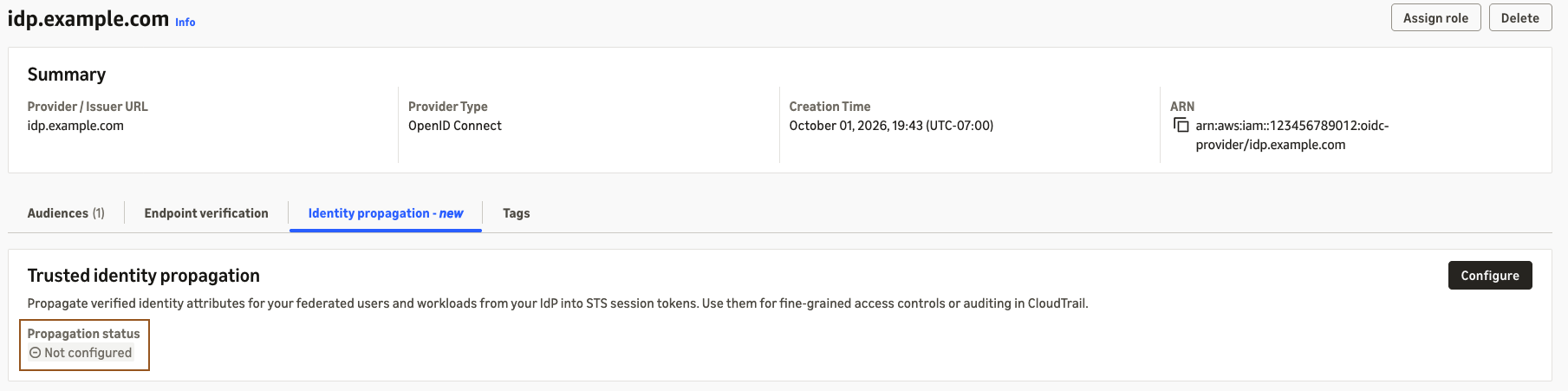
Choose the Identity propagation tab. Inspect Propagation status. A value of Not configured means that you can continue with this procedure. A value of Configured means that TIP is already configured for the provider.
-
Choose Configure.
-
Configure the template, Subject, optional Subject type, and runtime claims as described under Configure TIP when creating an OIDC provider, beginning with Start from a template.
-
If you require group-based access, keep Allow granting permissions to groups selected under Support group-based access for users and complete the applicable path in Configure group-based access for TIP. The console hides this section when Subject type is fixed to
workload. -
Choose Configure to save the configuration.
Add using the AWS CLI or AWS SDK
To add TIP to an existing OIDC provider, call the UpdateOpenIDConnectProvider API operation. Every API request includes the required OpenIDConnectProviderArn request parameter, which identifies the provider to update.
IAM does not accept ContextProvider and IdentityCenterInstanceArn in the same UpdateOpenIDConnectProvider request. Submit them in separate requests. The following sequence saves the TIP mappings first. Wait for the ContextProvider request to succeed, and then submit a second request with IdentityCenterInstanceArn to configure group-based access.
Prepare context-provider.json as described in the creation procedure.
AWS CLI
Use the aws iam update-open-id-connect-provider AWS CLI command.
To add TIP to an existing OIDC provider (AWS CLI)
-
Set
OIDC_PROVIDER_ARNto the ARN of the existing provider. -
Save the TIP mappings:
aws iam update-open-id-connect-provider \ --open-id-connect-provider-arn "$OIDC_PROVIDER_ARN" \ --context-provider file://context-provider.json -
If you require group-based access, wait for the first command to succeed, and then associate the IAM Identity Center instance:
aws iam update-open-id-connect-provider \ --open-id-connect-provider-arn "$OIDC_PROVIDER_ARN" \ --identity-center-instance-arn "$IDC_INSTANCE_ARN"
AWS SDK for Python (Boto3)
Use the update_open_id_connect_provider AWS SDK for Python method. Define the complete ContextProvider configuration as a Python dictionary.
import boto3 iam = boto3.client("iam") oidc_provider_arn = ( "arn:aws:iam::123456789012:oidc-provider/idp.example.com" ) context_provider = { "SubjectSourceKey": "sub", "SubjectTypeValue": "user", "KeyDefinitionList": [ { "SourceKey": "department", "TargetKey": "departmentName", } ], } iam.update_open_id_connect_provider( OpenIDConnectProviderArn=oidc_provider_arn, ContextProvider=context_provider, ) # Run this second API request only after the first request succeeds. iam.update_open_id_connect_provider( OpenIDConnectProviderArn=oidc_provider_arn, IdentityCenterInstanceArn=( "arn:aws:sso:::instance/ssoins-0123456789abcdef" ), )
Omit the second API request when group-based access is not required. Then verify the saved TIP configuration.
Change TIP configuration for an OIDC provider
Use this section to change the saved Subject, optional Subject type, runtime-claim mappings, or group-based-access configuration for an OIDC provider.
AWS Management Console
To change TIP configuration for an OIDC provider (console)
-
In the IAM console, choose Identity providers, and then choose the OIDC provider whose TIP configuration you want to change.
-
Choose the Identity propagation tab and verify that Propagation status is Configured.
-
Choose Edit. The edit flow displays the saved Subject, optional Subject type, runtime-claim mappings, and group-based-access settings instead of applying a template again.
-
Change the settings that you want to save.
-
To change group-based access or the associated IAM Identity Center instance, follow Change or remove group-based access. The console hides Support group-based access for users when Subject type is fixed to
workload. -
Choose Save changes.
Change using the UpdateOpenIDConnectProvider API
To change TIP programmatically, call the UpdateOpenIDConnectProvider API operation. Every API request must include the required OpenIDConnectProviderArn request parameter, which identifies the provider to update.
The request parameters fall into two categories. You can submit parameters from the same row together, but you cannot combine parameters from different rows.
What the API request updates |
Request parameters that can be submitted together |
|---|---|
OIDC provider and group-based access settings |
Either |
TIP mappings |
Either |
IAM rejects an API request that combines parameters from different rows. Wait for each API request to succeed before submitting the next request.
Example: Change TIP mappings with related OIDC provider settings
The following example demonstrates this requirement by changing the TIP mappings and group-based access through two API requests. First, it saves the TIP mappings through the ContextProvider request parameter. After that API request succeeds, it submits the IdentityCenterInstanceArn request parameter. If your workflow changes only TIP mappings, submit only the first API request.
Before submitting the TIP mapping API request, prepare the complete ContextProvider configuration that you want to save.
AWS CLI
Use the aws iam update-open-id-connect-provider AWS CLI command. Save the complete ContextProvider configuration as context-provider.json.
NEW_IDC_INSTANCE_ARN="arn:aws:sso:::instance/ssoins-0123456789abcdef" # First, change the TIP mappings. aws iam update-open-id-connect-provider \ --open-id-connect-provider-arn "$OIDC_PROVIDER_ARN" \ --context-provider file://context-provider.json # After the TIP mapping request succeeds, associate the # IAM Identity Center instance. aws iam update-open-id-connect-provider \ --open-id-connect-provider-arn "$OIDC_PROVIDER_ARN" \ --identity-center-instance-arn "$NEW_IDC_INSTANCE_ARN"
AWS SDK for Python (Boto3)
Use the update_open_id_connect_provider AWS SDK for Python method. Define the complete ContextProvider configuration in the context_provider dictionary.
import boto3 iam = boto3.client("iam") oidc_provider_arn = ( "arn:aws:iam::123456789012:oidc-provider/idp.example.com" ) new_instance_arn = ( "arn:aws:sso:::instance/ssoins-0123456789abcdef" ) context_provider = { "SubjectSourceKey": "sub", "SubjectTypeValue": "user", "KeyDefinitionList": [ { "SourceKey": "department", "TargetKey": "departmentName", } ], } # First, change the TIP mappings. iam.update_open_id_connect_provider( OpenIDConnectProviderArn=oidc_provider_arn, ContextProvider=context_provider, ) # After the TIP mapping request succeeds, associate the # IAM Identity Center instance. iam.update_open_id_connect_provider( OpenIDConnectProviderArn=oidc_provider_arn, IdentityCenterInstanceArn=new_instance_arn, )
To change thumbprints, use the existing UpdateOpenIDConnectProviderThumbprint API operation in a separate request.
If you remove group-based access while changing TIP mappings
If the workflow removes group-based access instead of associating an IAM Identity Center instance, reverse the order. First follow Remove group-based access to submit the RemoveIdentityCenterInstance Boolean request parameter set to true. After that API request succeeds, submit the revised ContextProvider request parameter.
This order removes group-based access before changing the TIP mappings.
After all applicable API requests succeed, verify the saved TIP configuration.
Each submitted ContextProvider replaces the complete saved ContextProvider structure. Include the Subject, optional Subject type, and every runtime-claim mapping that you want to retain. IAM removes optional members and mappings that are omitted from the submitted structure.
Verify the TIP configuration
Creating or updating an OIDC provider does not return the saved TIP mappings or enabled status. Verify that TIP is enabled and that IAM saved the intended ContextProvider configuration. You can verify these results in the IAM console or programmatically by using the GetOpenIDConnectProvider and ListOpenIDConnectProviders API operations.
AWS Management Console
To verify the TIP configuration (console)
-
In the IAM console, choose Identity providers, choose the OIDC provider, and then choose Identity propagation.
-
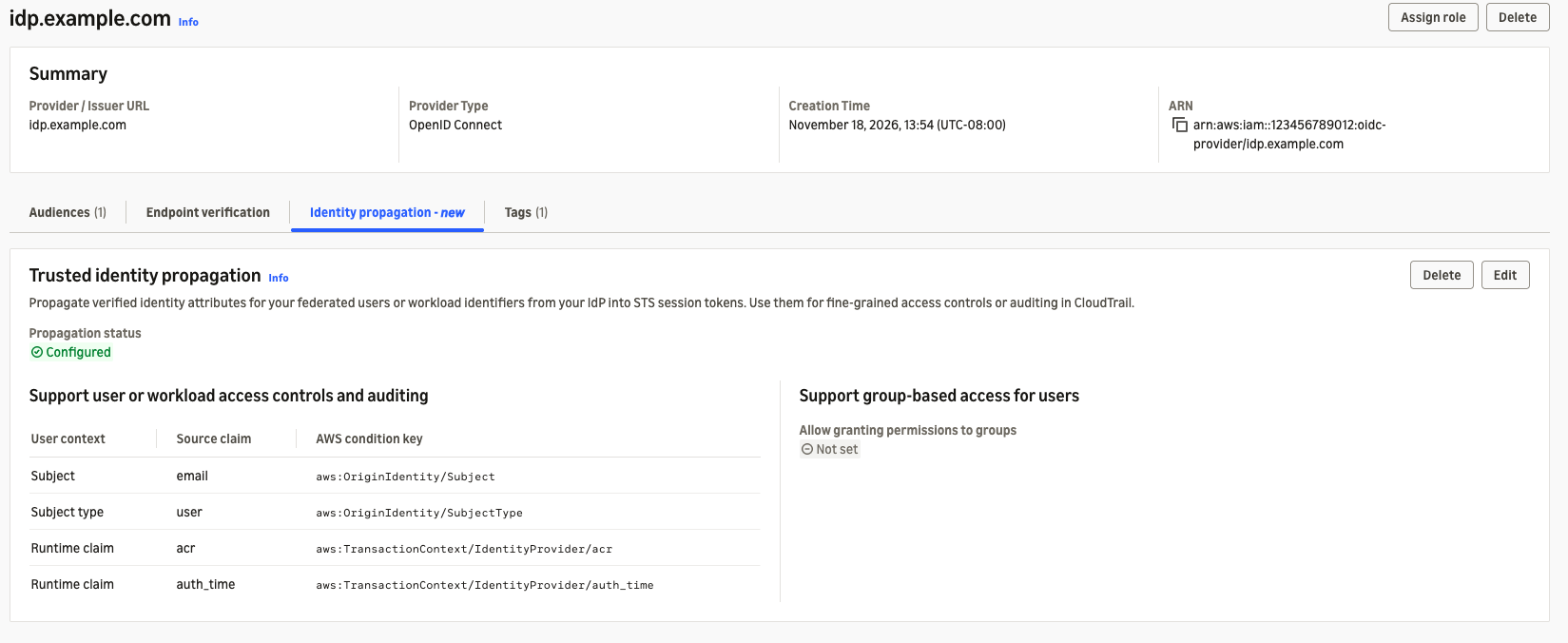
Inspect Propagation status. The expected value is Configured. A value of Not configured means that TIP is not configured.
-
In Support user or workload access controls and auditing, compare the displayed Subject source, optional Subject type, and every runtime-claim source and target with the values that you saved.
-
If a TIP value is missing or different, choose Edit, correct the configuration, save it, and repeat these checks.
-
If you configured group-based access, confirm that Connected IAM Identity Center instance shows the intended instance. Then follow Verify group-based access.
AWS CLI
First, use the aws iam list-open-id-connect-providers AWS CLI command to confirm that TIP is enabled:
aws iam list-open-id-connect-providers \ --query "OpenIDConnectProviderList[?Arn=='${OIDC_PROVIDER_ARN}'].{TIPEnabled:IsTrustedIdentityPropagationEnabled}" \ --output json
The query displays the IsTrustedIdentityPropagationEnabled response element using the shorter output label TIPEnabled. An enabled provider returns:
[ { "TIPEnabled": true } ]
A value of false means that the provider exists but TIP is disabled. An empty array ([]) means that no provider matched OIDC_PROVIDER_ARN.
Next, use the aws iam get-open-id-connect-provider AWS CLI command to retrieve the saved ContextProvider response element:
aws iam get-open-id-connect-provider \ --open-id-connect-provider-arn "$OIDC_PROVIDER_ARN" \ --query 'ContextProvider' \ --output json
For the example created earlier, the expected response is:
{
  "SubjectSourceKey": "sub",
  "SubjectTypeValue": "user",
  "KeyDefinitionList": [
    {
      "SourceKey": "department",
      "TargetKey": "departmentName"
    }
  ]
}
Use the response to verify the saved configuration:
-
SubjectSourceKeymust equalsub. -
SubjectTypeValuemust equaluser. -
KeyDefinitionListmust containdepartmentas the source anddepartmentNameas the target-key suffix.
A missing or different member means that the saved TIP configuration does not match the request.
If you configured group-based access, also follow Verify group-based access.
AWS SDK for Python (Boto3)
Use the get_open_id_connect_providerlist_open_id_connect_providers
import boto3


iam = boto3.client("iam")
oidc_provider_arn = (
    "arn:aws:iam::123456789012:oidc-provider/idp.example.com"
)
expected_context = {
    "SubjectSourceKey": "sub",
    "SubjectTypeValue": "user",
    "KeyDefinitionList": [
        {
            "SourceKey": "department",
            "TargetKey": "departmentName",
        }
    ],
}

saved = iam.get_open_id_connect_provider(
    OpenIDConnectProviderArn=oidc_provider_arn
)
provider = next(
    (
        item
        for item in iam.list_open_id_connect_providers()[
            "OpenIDConnectProviderList"
        ]
        if item["Arn"] == oidc_provider_arn
    ),
    None,
)

if provider is None:
    raise RuntimeError("The OIDC provider was not returned by the list operation.")
if saved.get("ContextProvider") != expected_context:
    raise RuntimeError("The saved TIP mappings do not match the request.")
if provider.get("IsTrustedIdentityPropagationEnabled") is not True:
    raise RuntimeError("TIP is not enabled for the OIDC provider.")

print("TIP configuration verified.")
For the example created earlier, the expected output is:
TIP configuration verified.
The script raises an error instead of printing the success message if the provider is missing, TIP is disabled, or the saved Subject, Subject type, or runtime-claim mappings differ from the request.
If you configured group-based access, also follow Verify group-based access.
Remove TIP from an OIDC provider
Removing TIP does not delete the OIDC provider.
AWS Management Console
To remove TIP from an OIDC provider (console)
-
In the IAM console, choose Identity providers, and then choose the OIDC provider from which you want to remove TIP.
-
Choose the Identity propagation tab and verify that Propagation status is Configured.
-
Choose Delete.
-
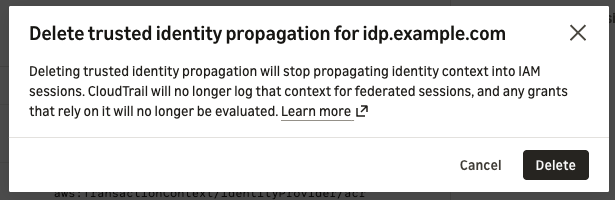
Review the effects of deleting TIP, and then choose Delete.
-
Return to the Identity propagation tab. The expected Propagation status is Not configured.
Remove using the UpdateOpenIDConnectProvider API
To remove TIP programmatically, call the UpdateOpenIDConnectProvider API operation. Every API request must include the required OpenIDConnectProviderArn request parameter.
If group-based access is configured, first submit an API request with the RemoveIdentityCenterInstance Boolean request parameter set to true. After that API request succeeds, submit a second API request with the RemoveContextProvider Boolean request parameter set to true. If group-based access is not configured, submit only the RemoveContextProvider API request.
AWS CLI
Use the aws iam update-open-id-connect-provider AWS CLI command.
To remove TIP from an OIDC provider (AWS CLI)
-
If group-based access is configured, run:
aws iam update-open-id-connect-provider \ --open-id-connect-provider-arn "$OIDC_PROVIDER_ARN" \ --remove-identity-center-instance -
After the first command succeeds, remove the TIP mappings:
aws iam update-open-id-connect-provider \
    --open-id-connect-provider-arn "$OIDC_PROVIDER_ARN" \
    --remove-context-provider
AWS SDK for Python (Boto3)
Use the update_open_id_connect_provider AWS SDK for Python method:
import boto3


iam = boto3.client("iam")
oidc_provider_arn = (
    "arn:aws:iam::123456789012:oidc-provider/idp.example.com"
)

# Run this API request only when group-based access is configured.
iam.update_open_id_connect_provider(
    OpenIDConnectProviderArn=oidc_provider_arn,
    RemoveIdentityCenterInstance=True,
)

# Run this API request after the instance-association request succeeds.
iam.update_open_id_connect_provider(
    OpenIDConnectProviderArn=oidc_provider_arn,
    RemoveContextProvider=True,
)
Verify that TIP was removed
Run the applicable AWS CLI commands or AWS SDK for Python methods in Verify the TIP configuration.
A successful removal has these results:
-
The
IsTrustedIdentityPropagationEnabledresponse element isfalse. -
The
ContextProviderresponse element is absent ornull.
A value of true for IsTrustedIdentityPropagationEnabled or a returned ContextProvider means that TIP remains configured.
If you also removed group-based access, follow Verify the removed association. The IdentityCenterInstanceArn and IdentityStoreArn response elements must be absent or null.
For TIP-specific configuration failures, see Troubleshoot TIP configuration.