Data perimeter for Amazon Bedrock: Securing generative AI workloads
Prashanth Sivarajan and Manigandan Shri, Amazon Web Services
April 2026 (document history)
Data Perimeter on
AWS
This article provides a comprehensive guide to address the AI-specific requirements by establishing perimeter controls around foundation models, custom models, knowledge bases, and the data that flows between them. It provides a structured implementation approach using Amazon Bedrock-specific policies and monitoring to ensure your AI applications operate within defined organizational boundaries.
This guidance is intended for Cloud architects and security engineers building a secure-by-default AI solution with Amazon Bedrock on AWS.
Overview
Amazon Bedrock workloads have unique characteristics that benefit from specialized data perimeter approaches. When you invoke foundation models, your prompts may contain business data, custom models store training datasets, and knowledge bases aggregate organizational documents. These AI-specific assets have different access patterns and data flows compared to traditional AWS resources.
Amazon Bedrock workloads often involve distributed architectures spanning multiple accounts for model sharing, automated pipelines for data processing, and real-time inference endpoints.
This distributed nature creates additional considerations for implementing effective perimeter controls.
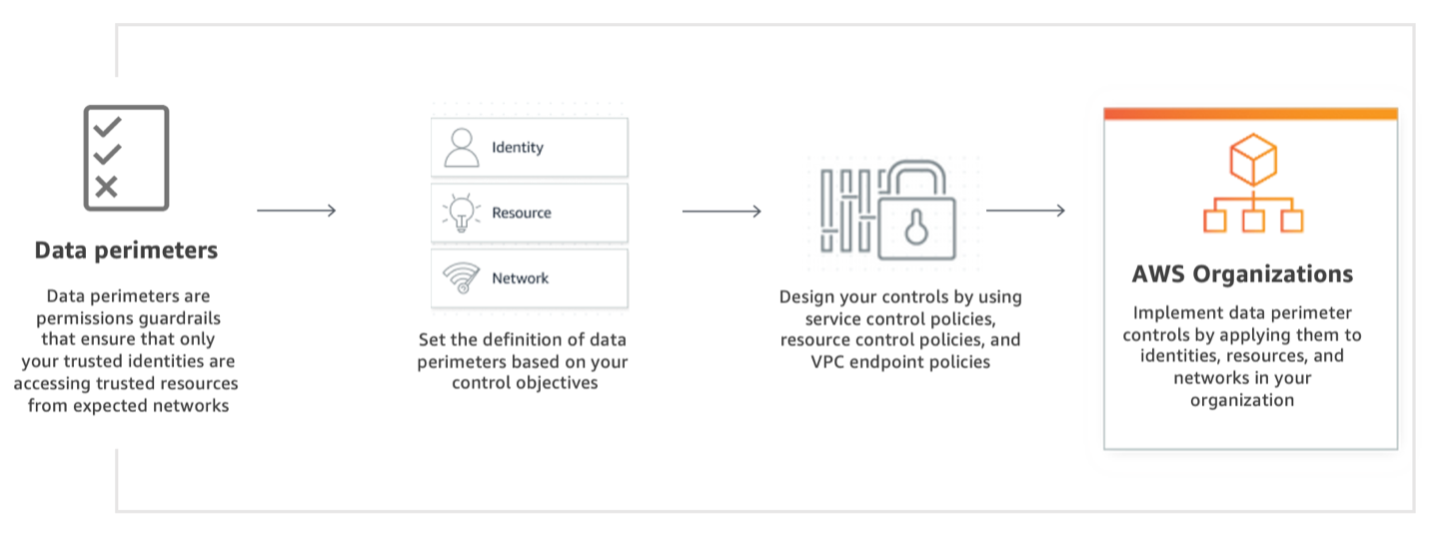
A data perimeter for Amazon Bedrock addresses these challenges through three AI-focused objectives:
Data perimeter objectives for Amazon Bedrock
Objective |
Definition |
Applied on |
Using |
Implementation Examples |
|---|---|---|---|---|
Identity Perimeter |
Only trusted identities can access my resources |
Resources |
Resource-based policy |
|
Only trusted identities are allowed from my network |
Network |
|
|
|
Resource Perimeter |
My identities can access only trusted resources |
Identities |
Service Control Policies (SCP) |
|
Only trusted resources can be accessed from my network |
Network |
|
|
|
Network Perimeter |
My identities can access resources only from expected networks |
Identities |
Service control policies (SCP) |
|
My resources can only be accessed from expected networks |
Resources |
Resource-based policy |
|
These preventive guardrails are critical for Amazon Bedrock deployments where sensitive prompts, training datasets, and model artifacts require protection from unauthorized access and data exfiltration.
For example, a healthcare organization using Amazon Bedrock to analyze patient records needs to ensure:
-
Their custom medical models are only accessible by authorized clinical applications
-
Their AI systems never send data to external models
-
All patient prompts travel through HIPAA-compliant network paths
Business Outcome
Implementing these controls provides clear visibility into data access patterns, streamlines compliance reporting, and establishes consistent security policies across AI workloads. This creates a foundation for scaling AI initiatives while maintaining operational control and meeting regulatory requirements. The approach enables teams to innovate confidently while maintaining security baseline.